



As electricity prices keep climbing for stores and homes concentrated throughout the ACT and an increasing number of households impartial knocks on installing rooftop solar systems, numerous property owners are leaping up with a sensible follow up inquiry: Are solar batteries in Canberra worth it in 2026?
Battery storage is here to stay as no longer a fringe technology. It has gone mainstream for solar homes planning to install solar in the near future. Still, batteries are a lot of money and the decision deserves a paragogy inclusive of numbers, not some hype.
This guide examines solar battery systems in the ACT in a neutral educational light. We’ll look at how they work, the cost of them, how the payback is worked out and which households they benefit most. By the end, you should have a realistic framework to make your own decision if home battery storage will make sense for your situation in 2026.
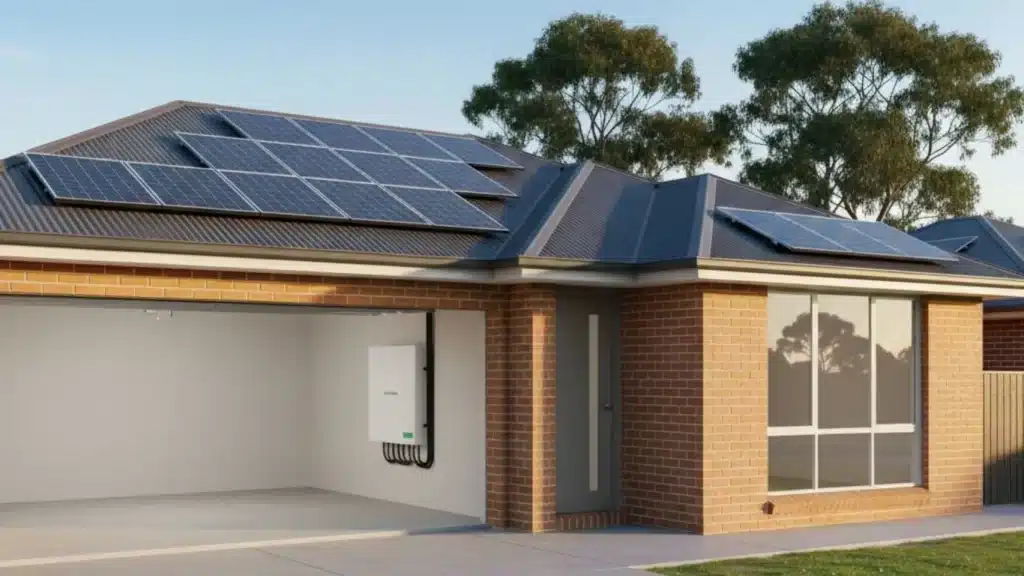
Understanding Solar Battery Storage
A solar battery is used in tandem with your rooftop solar system to store any excess electricity that is produced during the day/working hours. Instead of exporting unused energy to the grid for a low feed-in tariff, that power is saved and used at a later time – normally in the evening or early morning.
In more practical terms, a battery aids in helping you.
- Upgrade your e-mail to using more of your own solar energy
- Limit the need to use grid electricity at the time of night
- Receive some protection against the future increase in price
- Prolong outages while maintaining limited power (the compatible systems available).
Home battery storage in Canberra has been steadily increasing due to the increase in energy independence as households aim to lower their bills, especially as feed-in tariffs keep dropping.
Why Batteries Are Getting Considered More Seriously In 2026
Several factors have made batteries powered by the sun more relevant than they weren’t even five years ago.
Rising Electricity Prices
Grid electricity prices in the ACT are also at the highest in Australia. Time-of-use pricing means that evening electricity (which is the time when most households consume the most electricity) is also the most expensive.
The use of a battery is to eliminate the necessity of having to buy power during these peak times.
Lower Feed-In Tariffs
Exporting solar energy to the grid is much less profitable than before. Many households are now being paid only a few cents per kilowatt-hour for exported power.
Storing and using your own energy is very valuable in many cases rather than selling it back.
Improved Batteries Technology
More efficient, safer, and longer-lasting lithium-ion batteries were not mentioned in early-generation battery systems. Most are now available with 10 year warranties and predictable performances/curves.
Increased Attention to Energy Resilience
Storms- grid improvements and peak demand events have made people aware of supply cuts. While most home batteries won’t turn on a whole house in case of an outage due to lack of power, many support the function of backing up your essential circuits.
Solar Batteries Canberra: What is the Way the Systems Usually Work Boyd
Normally for solar battery system in place we have:
- Rooftop solar panels
- A hybrid or battery ready inverter
- A lithium-ion battery unit
- Monitoring software
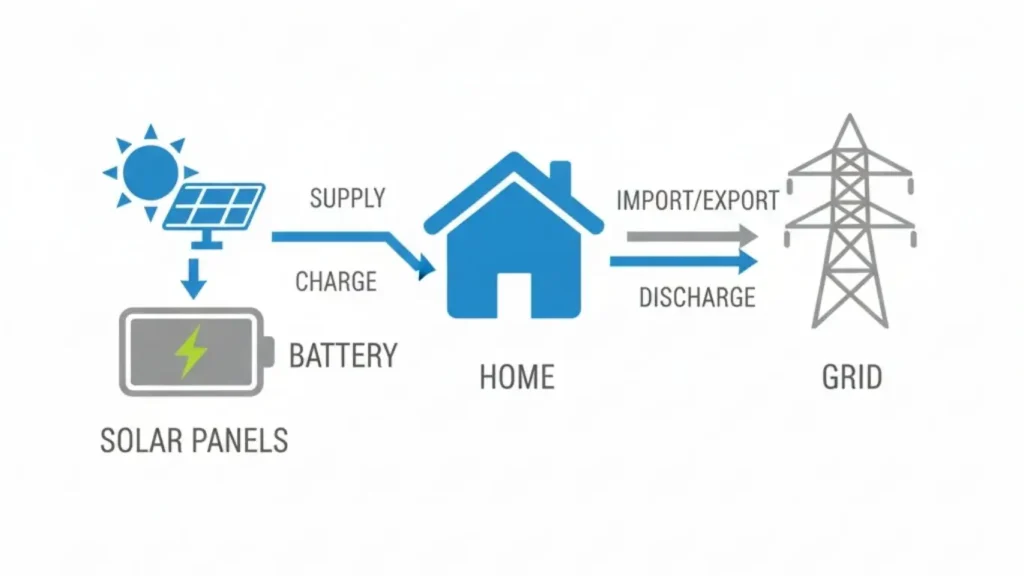
During daylight hours:
- First to be powered by solar panels, they will power your home.
- Excess energy causes a-charging the battery
- Any surplus left is exported out with the grid
After sunset:
- Your home broadband, summoning the internet, opening the shutters on air conditioners and other such appliances all riding on the electrical power drawn from the battery before it switches to grid electricity
This is the basic operating logic behind solar battery payback in the first place and it is the basic formula responsible for solar battery payback over time.
Solar Battery Price Canberra What Do Systems Cost In 2026
Battery pricing is the greatest hurdle for too many households. While there has been a gradual drop in costs, they are significant.
Typical and Price Ranges for an Installed
It is known that in Canberra, the cost of a fully installed home battery system is in the order of:
- Small systems (5-7 kWh): $4,500
- Medium systems (9-13 kWh): $4,900
- Large systems (15+ kWh): $7,999
Prices vary based on:
- Battery brand and chemistry
- Storage capacity
- Inverter compatibility
- Installation complexity
- Backup functionality
These numbers assume there are no major switchboard improvements and there are no unusual site conditions.
What Affects the Value of a Battery More than Price
The initial cost alone does not show whether or not a battery is worth it. Several household-specific factors are more important.
Daily Energy Usage Patterns
Batteries have the greatest return to homes that:
- Use significant electricity around evening time, in the evening
- Have predictable consumption on a daily basis
- Run appliances after sunset
However, households with mainly day time usage, often reap less benefits.
Solar System Size
A battery has to be well charged to provide value. However, homes with undersized solar systems can sometimes have problems filling a battery on a regular basis, particularly during the winter months.
Export vs Self-Consumption
The larger the difference between electricity prices in the grid and feed-in tariffs the stronger the business case for storage.
Battery Sizing
Oversized batteries are slower to pay off. Undersized batteries may not be able to meet evening demand. Correct sizing is critical.
Solar Battery Payback: How Does It Eventuate in Actuality?
Solar battery payback: Payback refers to the period in which the savings of energy supplied will match the initial cost of the battery.
Solar battery payback: Payback is the time taken for the energy savings to offset the initial expense of the battery.
Payback periods in 2026 for Canberra generally range from:
- 8-12 years for well fit systems
- 12-15 years for average usage homes
This assumes:
- Stabilized or increasing electricity prices
- Regular behaviour in terms of energy at home
- Minimal Decline of Battery outside Warranty Expectations
Batteries are not a quick returning investment. They are a better model of a long-term energy strategy rather than an immediate short-term win for the grocer.
Financial v/s Non-Financial Benefits
While payback is important, many homeowners are not choosing batteries for the simple fact of saving money.
Financial Considerations
- A reduction of grid electricity purchasing
- Protection against future tariffs increases
- Increased solar self consumption
Non-Financial Benefits
- Increases in energy independence
- Backup power during outage (system dependent)
- Reduced effect on the environment
- Better use of existing solar-caused investment
For some households, these non-financial benefits make the decision to go for payback marginal.
Performance in Canberra throughout the Year
Canberra Climate Cases battery the climate uses two form at battery performance value canberra
Summer
- High solar generation
- Batteries fill easily
- High evening coverage of usage
Winter
- Shorter days
- Lower solar output
- Batteries may not fully charge on a daily basis
This seasonal imbalance is what is normal, and should be taken into consideration when having realistic expectations.
Battery Expected Life Span and Degradation
By most modern standards, batteries are rated for:
- 6,000-10,000 cycles
- 10-year warranties
- 60-80% capacity of retention at warranty end
Degradation Calais is gradual and predictable. While capacity decreases over time it is common for most systems to prove useful storage well beyond the warranty period.
Home Battery Storage Canberra – Are you Right for It?
A battery is more likely to be worth it if you:
- Already have solar installed
- Use large quantities of electricity for evenings
- Plan to be in your home for an extended period of time
- Value energy independence
It may be less suitable if you:
- Rent or plan to move soon
- Have absolutely lowest electricity consumption
- Export the majority during the day
Common Myths About Solar Batteries
1. “Batteries cancel out the power bills entirely.”
Not usually. Most homes continue to operate on some amount of grid electricity (especially in the winter).
2. “Bigger batteries are always better.”
At this level, Donald Gieske, Regional Services Manager of the Illinois Central Railroad – now i.e.T.
Oversizing – oversizing causes poor financial efficiency.
3. “Right now batteries are only good for blackouts.”
Backup is a bonus, but daily energy shifting is the main value drive.

The Contribution of Professional Assessment
Battery value is very dependent on correct system design. A proper assessment includes the following:
- History of electricity consumption
- Solar production modelling
- Load profile evaluation
- Future energy needs
Generic recommendations seldom make for optimal results.
Final Thoughts: Are Solar Batteries Worth It in 2026?
For a number of ACT households, solar batteries in Canberra are approaching being a measured and long term investment, not a luxury. The ones that make the most sense are the ones that follow good usage patterns, are properly sized for the system, and involve long-term home ownership.
They are not a panacea and they are not a win in the financial markets. However, for the right home, there are significant meaningful savings in energy bills, greater control over energy costs, and resilience in an evolving energy market to be had by using a battery in the home.
If you are thinking of home battery storage then the most important thing you can do is to understand your own energy behaviour – not to be swayed by the promise of instant loads of return on investment.
FAQs
1. What will the price of a solar battery installation be in Canberra by 2026?
Solar battery installations vary based on their size and brand but tend to be relatively inexpensive for small batteries that only provide light use at night, whereas larger batteries that offer backup will generally be more costly. Additionally, installation difficulties (e.g., the cost of installing a compatible inverter, upgrading the switchboard) may impact the final price. Be sure to include the cost of your complete battery system when evaluating how much you can expect to pay.
2. How long can I expect it to take for me to break even on my solar battery purchase in the ACT?
On average, the time it takes to recoup the costs of purchasing and installing a battery in an average Canberran will be between 8 and 15 years. Households that use a lot of their stored energy at night will be able to return their investment sooner than households that don’t. However, the time needed to recover your battery costs will vary significantly based on your energy tariff rates/credit available for any discounts or government rebates, as well as how much of your stored energy you are able to utilize at night.
3. Will a solar-powered battery completely eliminate my overall electricity usage?
There will usually still be some electricity used from the grid, although a battery can greatly decrease the overall amount of electricity drawn from the grid, especially in winter months or long cloudy periods. Most homes will still utilize some amount of electricity from the grid, but a solar-powered battery is mainly used to reduce energy costs and provide independence from the grid’s pricing structure without completely eliminating your reliance on grid energy.
4. Do solar batteries continue to provide power in case of a blackout?
Not all battery systems have the backup functionality, it is true that some of them have it. If having backup power is important to you, then the system has to be made, from its design, specifically with that feature. Moreover, the majority of home batteries usually supply essential circuits only, for example, lighting, refrigeration, and certain outlets, not the whole house.
5. Are solar batteries a good investment if I have solar panels already?
Adding a battery can allow a homeowner in Canberra with solar panels to increase self consumption and reduce reliance on peak, rate electricity. The question of whether it is a good investment depends on your energy usage patterns, how long you are going to live in the house and your energy independence and financial return priorities.
Thinking About Adding a Battery to Your Solar System?
Every home is different, and the value of battery storage depends on how you use energy day to day. If you’d like clear advice based on your actual electricity usage, not sales pressure, the team at Woden Valley Solar and Electrical can help.
We provide practical assessments, realistic payback estimates, and tailored recommendations for ACT homes.
Ph: 0431 262 728
Email: info@wodenvalleysolarnelectrical.com.au
Get informed. Get clarity. Then decide what’s right for your home